
Friday was rough to be sure… the biggest daily loss in several months, rooted in scary rhetoric. Just don’t jump to conclusions. As hard as the bears hit, neither of the indices really threatened to break under even the nearest of technical support levels. In other words, the bull market is still alive, with no real evidence that a correction is underway.
Never say never though. The market certainly ended last week within striking distance of starting a more serious pullback.
We’ll take a detailed look at the action in a moment. Let’s first review last week’s more important economic announcements and preview what’s coming this week. Spoiler alert: We’re really going to round out real estate’s current report card.
Economic Data Analysis
The holiday-shortened week started in earnest on Wednesday, with last month’s housing starts and building permits. Permits were roughly in line with December’s figure, while starts stepped back from December’s pace back to near last year’s lows.
Housing Starts and Building Permits Charts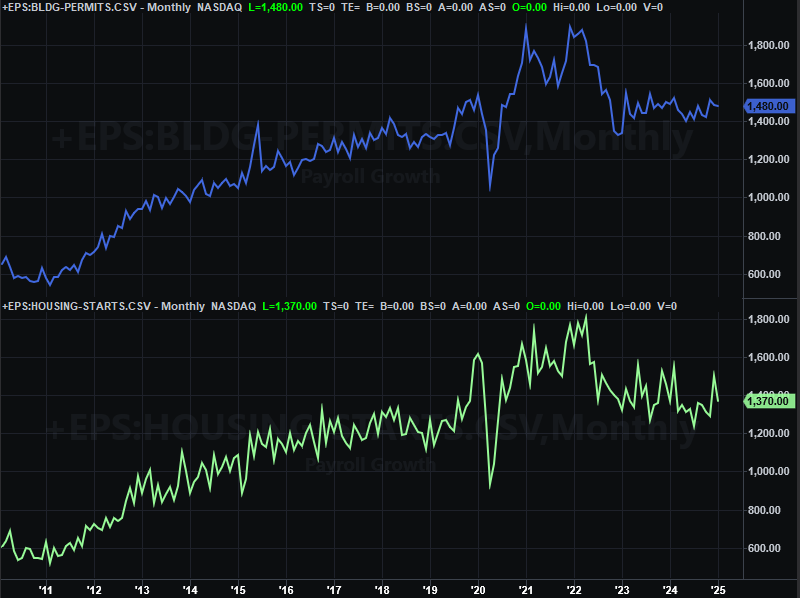
Source: U.S. Census Bureau, TradeStation
In short, while there’s no worsening here, there’s no measurable improvement in starts and permits either.
Ditto for home sales… existing home sales anyway. Economists rightfully had the feeling they’d fall from December’s annualized pace of 4.29 million, but they fell more than expected to 4.08 million. Again, things aren’t getting worse, but they’re certainly not getting better.
New, Existing Home Sales Charts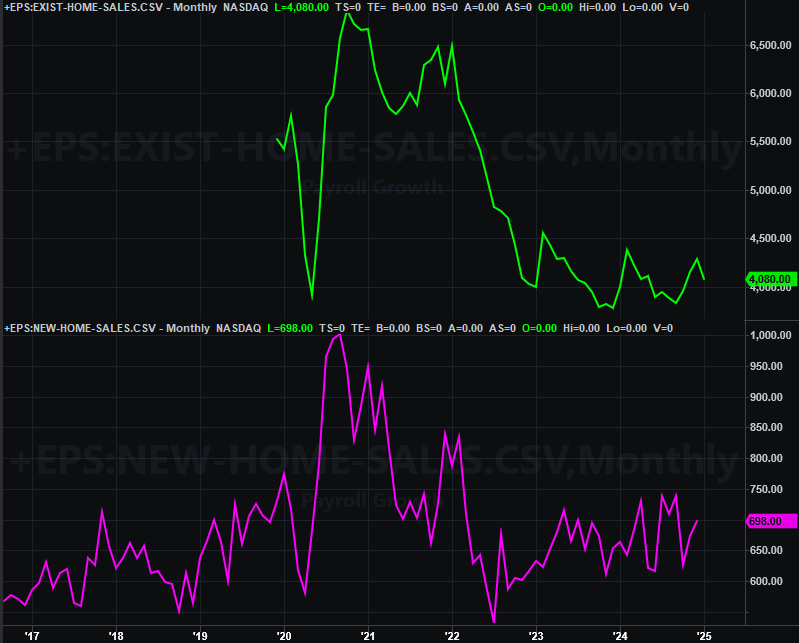
Source: National Assn. of Realtors, U.S. Census Bureau, TradeStation
January’s new home sales number will be released on Wednesday of this week. Look for a similarly-sized setback.
Everything else is on the grid.
Economic Data Report Calendar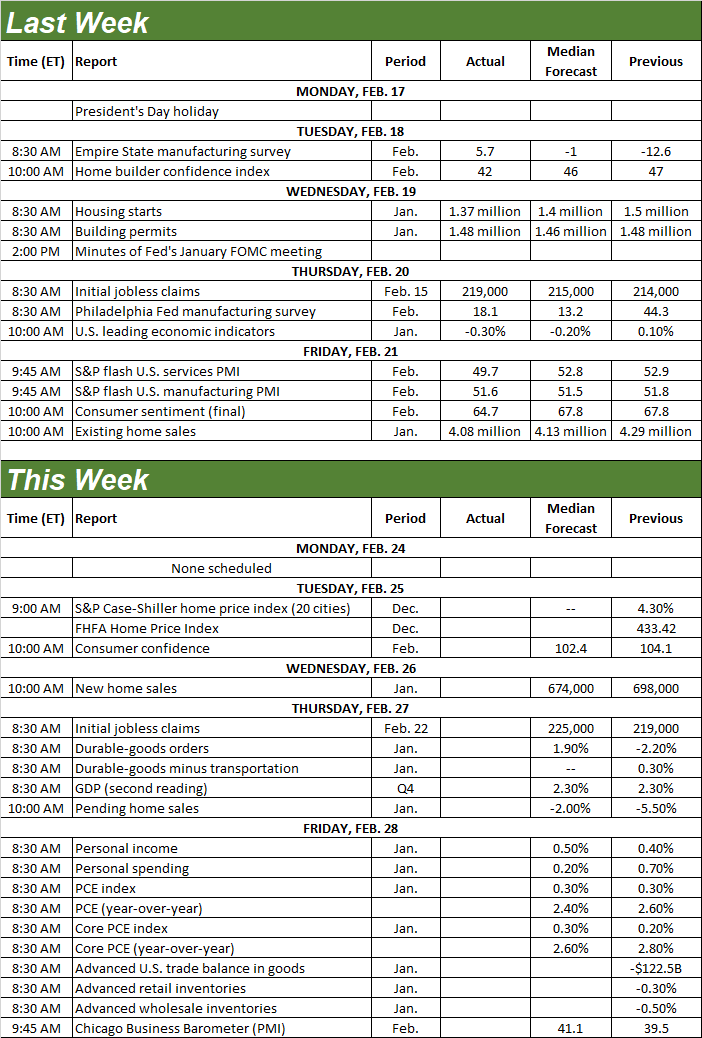
Source: Briefing.com, TradeStation
We’ll get the pricing picture this week. Specifically, we’ll hear the Case-Shiller as well as the FHFA’s home price index updates on Tuesday. Although they’re only for December, this will still be telling information as to how healthy real estate really is right now.
Home Price Index Charts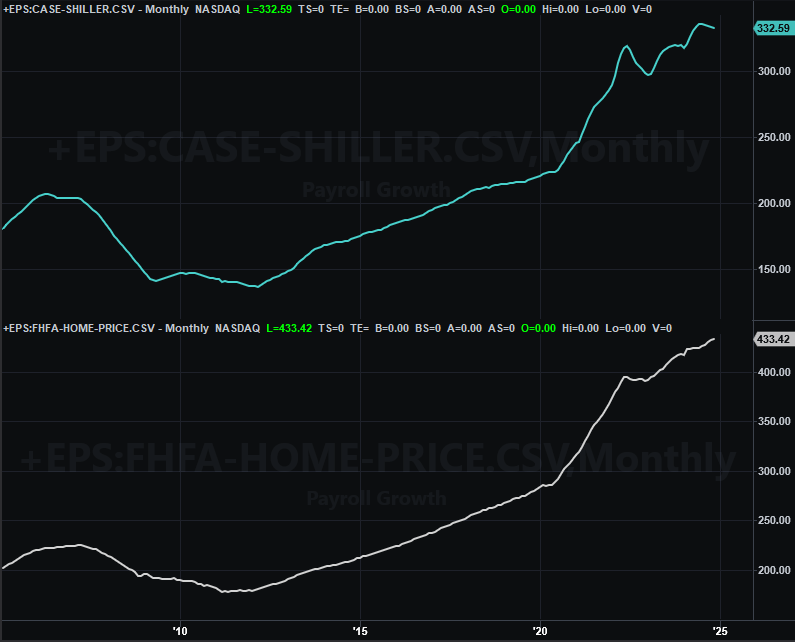
Source: FHFA, Standard & Poor’s, TradeStation
Also on Tuesday look for The Conference Board’s consumer confidence score for February. As the University of Michigan’s sentiment score did, economists believe confidence also took a slight tumble for the month. (Note that the image below is only updated through January.)
Consumer Sentiment Charts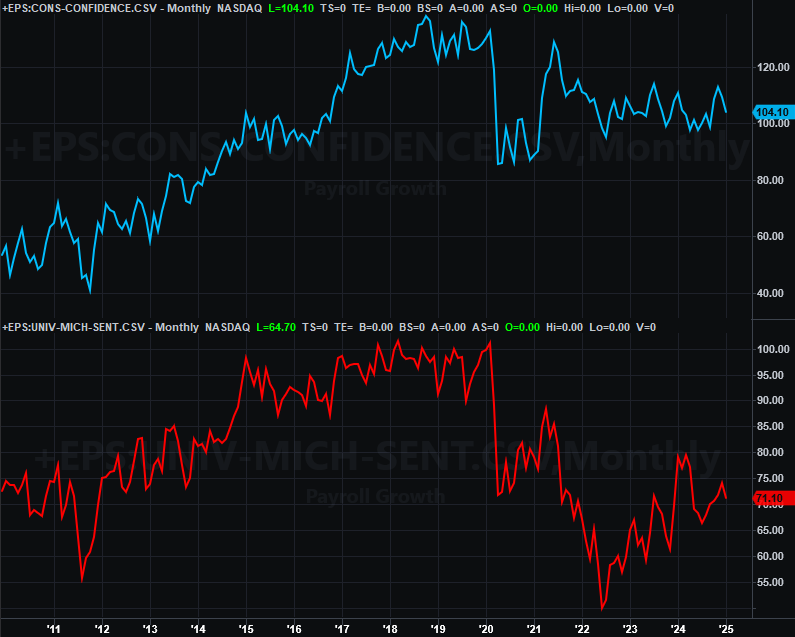
Source: Conference Board, University of Michigan, TradeStation
Finally, although we’re not charting it here, know that the consumer spending and personal income figures for January will be released on Friday. They should be roughly in line with December’s changes, which suggests continued reasonably healthy growth that could prevent the FOMC from cutting interest rates quite as aggressively as it recently suggested it might want to.
Also know the second (of three) updates of Q4’s GDP growth will be posted on Thursday. It’s expected to remain at a decent 2.3%.
Stock Market Index Analysis
As crazy as it may seem to hear it as well as say it, last week’s setback wasn’t all that damaging. Sure, Friday’s tumble was uncharacteristically painful, but hardly unheard of. More to the point, the 1.7% selloff from the S&P 500 didn’t actually pull the index under its most important technical support right now. That’s its 50-day moving average line, plotted in purple on the daily chart below.
S&P 500 Daily Chart, with VIX and Volume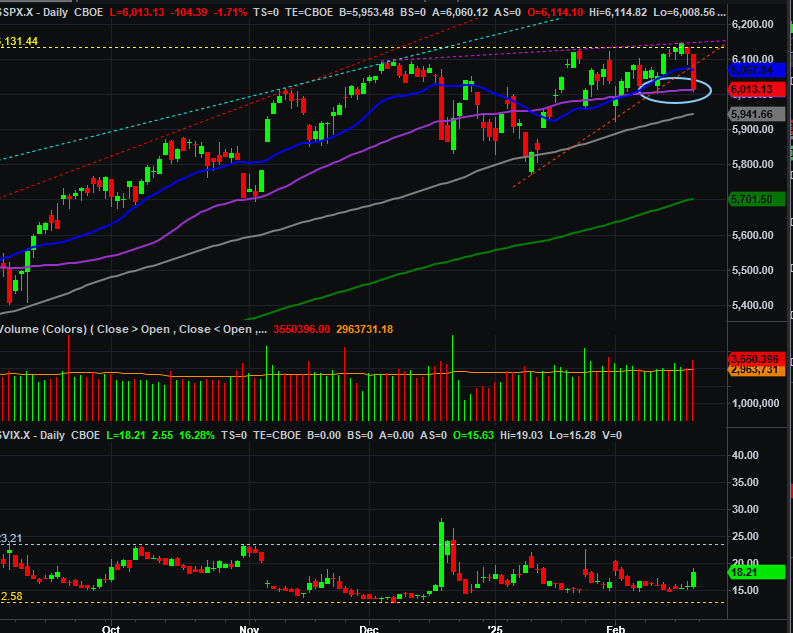
Source: TradeNavigator
The NASDAQ Composite didn’t hold up quite as well. Unlike the S&P 500, didn’t brush new-high territory on Tuesday. And, also unlike the S&P 500, the composite ended Friday’s action just a little bit below a couple of key technical floors. All the same, it’s not as if the NASDAQ actually logged a new lower low that you’d expect to see when the tide takes a turn for worse.
NASDAQ Composite Daily Chart, with VXN and Volume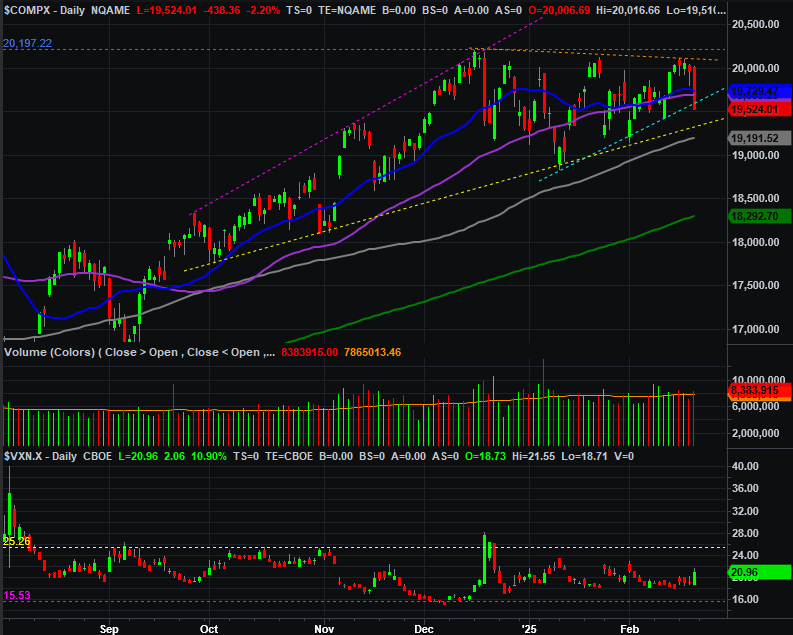
Source: TradeNavigator
The weekly chart of the NASDAQ Composite puts this resilience in its proper perspective. The composite isn’t even in the lower half of the rising bullish channel that’s been steering it higher since early-2023. It’s not even testing the midpoint of this bullish trading range.
NASDAQ Composite Weekly Chart, with VIX and MACD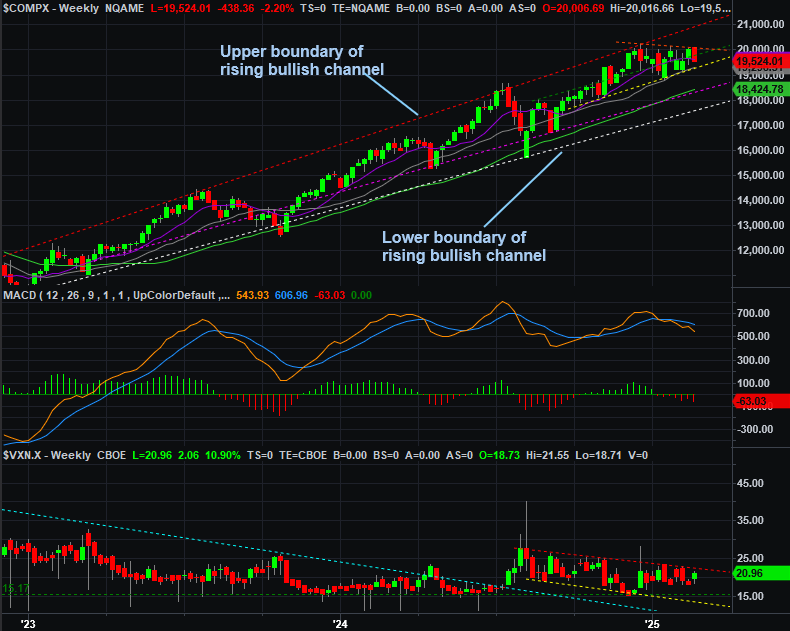
Source: TradeNavigator
Still, the composite’s weekly chart shows us something that’s not readily apparent on either of the daily chart. That’s the way both of the MACD lines are still falling after they dished out a bearish divergence early in the year. It’s not exactly bee clear which direction the tides have been moving with just a look at the market’s recent action. With the falling MACD lines though, it’s difficult to argue the undertow isn’t bearish even if the NASDAQ isn’t actually losing net ground yet.
The weekly chart of the NASDAQ Composite also shows us a volatility index (or VXN) that’s once again knocking on the door of a falling resistance line (red, dashed). If it does punch through, we’ll very likely see the NASDAQ itself break under technical support and at least get a small corrective move going.
The weekly chart of the S&P 500 is in a similar (albeit not identical) scenario. That is, its MACD indicator is still leaning in a bearish direction. Also notice there does seem to be something of a horizontal technical ceiling in the 6,130 area (pink, dashed) even if it’s not super-precise.
S&P 500 Weekly Chart, with VIX and MACD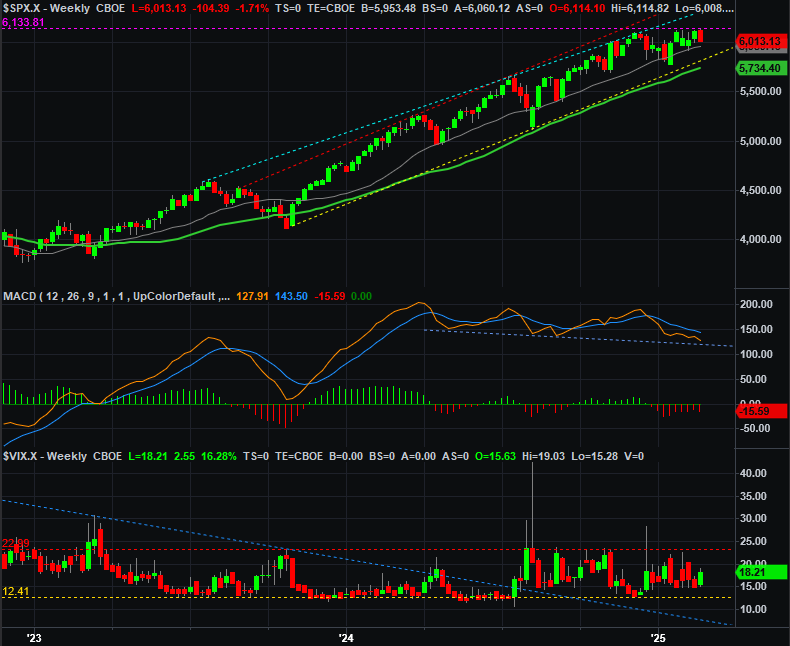
Source: TradeNavigator
And for what it’s worth, not that it matters yet (or ever will), the S&P 500’s ultimate technical floor is very well defined with the weekly chart. It’s the general convergence of its 200-day moving average line (green) and the lower boundary of its bullish channel that extends all the way back to 2023 (yellow, dashed), currently around 5,800. We’ll assume that’s going to hold up as a floor for now, although if for some reason things get uglier than expected, that will likely be the index’s make-or-break point that opens the selling floodgates. The S&P 500’s volatility index (the VIX) will of course also pop above its recent ceiling around 23 if that’s what’s in the cards.
Whatever the case, for the time being your marching orders are to do nothing but wait. The bulls aren’t quite sure what to make of Friday’s tumble. For that matter, not all the bears are sure either.