How avoiding groupthink can pay off for investors
by Simon Maeirhofer [1]
What does it take to be a successful investor? There are many requirements, but one of the most important, in my humble opinion, is the ability to tune out the noise and objectively assess the emotional state of the media/investment community.
When groupthink becomes a strong force, it's often a good time to start swimming against the stream. Admittedly, the indicator I'm about to introduce is more anecdotal than scientific, but has proven very effective. That indicator concerns the news cycle and investors’ response to it.
For example, at the beginning of the year, the “bear market virus” infected Wall Street, the media and investors, and ultimately robbed them of a good buying opportunity.
On Jan. 27, when the S&P 500 (SPX) (SPY) traded around 1,900, I published a bullish column asserting that the S&P could revisit all-time highs .
Although the column stated that: "We'd like to see another leg to new lows for a more sustainable bottom" (which happened in February), the notion of revisiting all-time highs was highly contrarian, and as it turns out (based on Marketwatch reader comments) controversial. Below are just a few examples:
- “S&P reverting to all time high! Snake Oil Salesman Alert ….!!!!!!!!!!!!!!!”
- “This article is a bull's 1% hope after a bear market has already begun.”
- “Having read only the headline, I have only two words: Dream on!”
- “Seriously? One good morning for the market and now we're going to all time high. This is ridiculous.”
- “Hard to see where the earnings come from to propel the market back to highs. Hard to believe we will see a rush of greater fools too.”
- “Bounces are always possible. However, the long term is bearish. Have a look at the monthly MACD, an indicator that signaled the beginning of every bear or bull market. It shows that we are already in a bear market.”
Having your work publicly mocked and picked apart is not the most pleasant of experiences, but it's often an indication that one may be on to something (the angry reception, along with other signals, contributed to our buy signal on Feb. 11 at S&P 1,828).
No guts, no glory
Swimming against the stream takes more effort than floating with the current, just as investing contrary to the crowd takes more mental effort than going with the flow. No guts, no glory.
However, the post-2009 market has proven again and again that a “watched pot doesn't boil.” In other words, when everyone expects a bear market, it's unlikely to show up. Bears are shy and arrive unannounced.
2007 vs. 2013
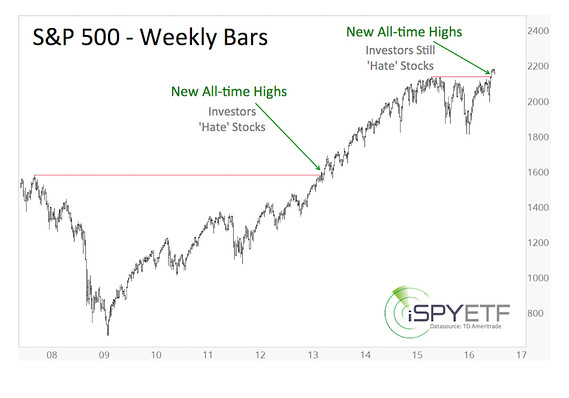
In March 2013, the S&P 500 surpassed its 2007 all-time high. The March 10, 2013, we noted the following:
"The Dow surpassed its 2007 high and set a new all-time high last week, but investors seem to embrace this rally only begrudgingly, and the media is quick to point out the 'elephant in the room' — stocks are only up because of the Fed. Below are a few of last week's headlines:
“CNBC: Dow Breaks Record, But Party Unlikely To Last [2]
“Washington Post: Dow Hits Record High As Markets Are Undaunted By Tepid Economic Growth, Political Gridlock [3]
“The Atlantic: This Is America, Now: The Dow Hits A Record High With Household Income At A Decade Low [4]
“CNNMoney: Dow Record? Who Cares? Economy Still Stinks [5]
“Reuters: Dow Surges To New Closing High On Economy, Fed's Help [6]
The market likes to fool as many as possible and it seems that overall further gains would befuddle the greater number. Sentiment allows for further gains."
 [7]
[7]
2015 vs. 2016
After a 14-month struggle, the S&P 500 surpassed its 2015 all-time high on July 11, 2016.
How was the July breakout to new all-time highs received? Suspiciously, as the headlines below show:
- Bloomberg: As Markets Reach new highs, World's Top Investors Ring Alarm [8]
- Barron's: 3 Reasons to Worry that Stocks Rally's End is Near [9]
- MarketWatch: 3 Reasons Why you Shouldn't Buy into the S&P 500 Breakout [10]
The non-scientific headline/comment indicator suggests there's more up side longer-term. Shorter-term, the S&P may suffer a bit from recent bearish divergences.
Courtesy of marketwatch.com [11]